


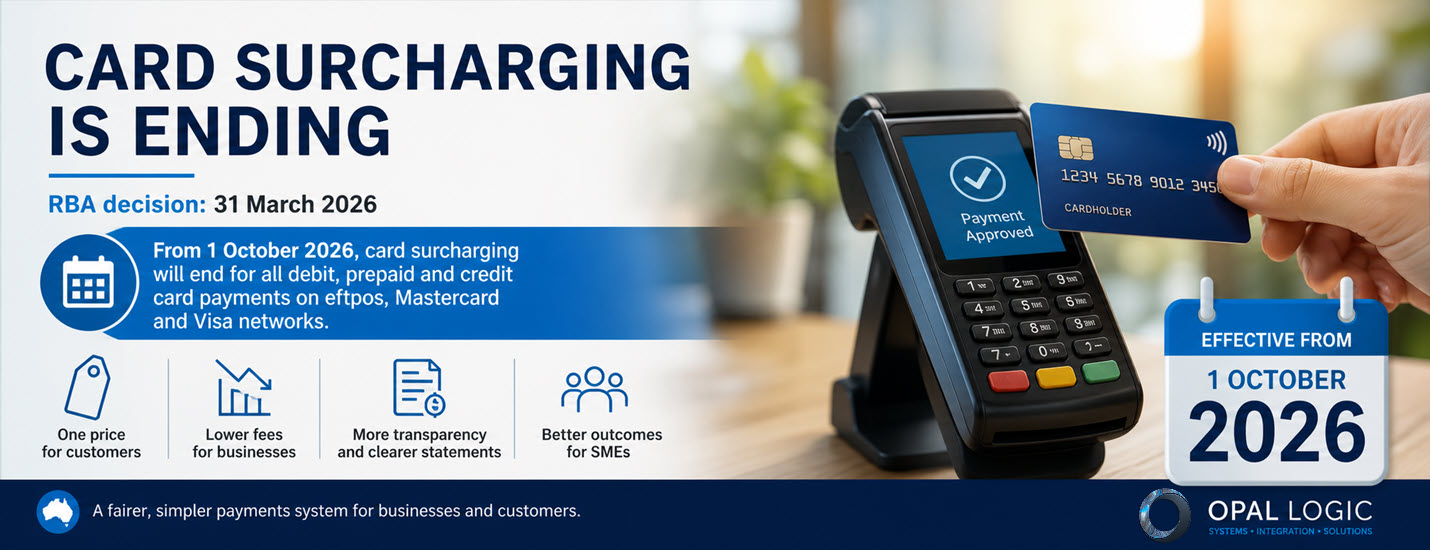
RBA Card Surcharge Changes: What the 1 October 2026 Ban Means for Australian SMEs
On 31 March 2026, the Reserve Bank of Australia announced a major change to card payments in Australia.
From 1 October 2026, businesses will no longer be able to apply card surcharges to payments made through the eftpos, Mastercard, and Visa networks. This includes debit, prepaid and credit card payments.
For customers, the change is straightforward: fewer surprise fees at checkout.
For small to medium businesses, the impact is broader. It affects pricing, merchant fees, point-of-sale systems, online payments, accounting processes, ERP configuration and customer communications.
What is changing?
The RBA’s decision allows EFTPOS, Mastercard, and Visa to prevent businesses from applying surcharges on their card networks. In practical terms, most businesses should prepare for a future where the advertised price is the price the customer pays, without a separate card surcharge added at checkout.
The reform is not only about removing surcharges. The RBA is also reducing interchange fee caps and introducing greater payment fee transparency. These changes are intended to lower merchant costs and make it easier for businesses to compare payment providers.
This matters because surcharging was originally designed to help customers choose lower-cost payment methods. But the payments market has changed. Card payments are now the default for many Australians, cash use has declined, and surcharges have become a point of confusion and frustration for customers.
Why this matters for SMEs
Many small and medium businesses currently use card surcharges to recover merchant service fees. From October 2026, that model will need to change.
Businesses will need to decide whether to absorb card payment costs, adjust prices, renegotiate payment provider fees, or encourage lower-cost payment methods in other ways.
The good news is that the RBA expects small businesses to benefit from lower payment costs, particularly where they currently pay higher merchant fees. But those benefits will not happen automatically for every business. SMEs will still need to review their merchant arrangements, systems and pricing models.
Key areas SMEs should review
1. Pricing and margins
If your business currently applies a card surcharge, you will need to consider how payment costs will be recovered after 1 October 2026.
This may involve reviewing:
- retail prices
- service fees
- online checkout pricing
- invoice payment terms
- delivery or booking fees
- recurring billing arrangements
The goal is not necessarily to increase prices across the board. The goal is to understand your true cost of accepting payments and make a deliberate pricing decision before the change takes effect.
2. POS, ERP and payment systems
For many businesses, surcharge rules are configured in more than one place.
They may exist in:
- POS terminals
- eCommerce platforms
- payment gateways
- accounting software
- ERP systems
- invoice payment links
- customer portals
- custom integrations
This is especially important for businesses using integrated platforms such as Jiwa Financials, MYOB Exo or other ERP and financial systems. A surcharge may be applied by a terminal, a gateway, an invoice template, a debtor payment portal or a custom workflow.
Before October 2026, these settings should be identified, updated and tested.
3. Merchant fees and payment provider contracts
The removal of surcharging makes merchant fees more important, not less.
Businesses should review recent merchant statements and understand what they are paying by payment type and channel. This includes card-present transactions, online payments, invoice payment links and recurring payments.
Important items to review include:
- merchant service fees
- interchange and scheme fees
- gateway fees
- terminal rental fees
- chargeback fees
- settlement timing
- blended versus interchange-plus pricing
- least-cost routing availability
If your merchant facility has not been reviewed recently, this reform is a good reason to compare providers and renegotiate.
4. Least-cost routing
For debit card payments, least-cost routing can help route transactions through the lowest-cost available network.
Not all terminals, gateways or providers handle this in the same way. Some businesses may already have least-cost routing enabled, while others may not.
SMEs should ask their payment provider whether least-cost routing is active across all relevant payment channels, including in-store and online payments where available.
5. Customer-facing wording
Any customer-facing references to card surcharges should be reviewed before the change takes effect.
This may include:
- website checkout pages
- invoice footers
- quote templates
- booking forms
- customer portal instructions
- payment reminder emails
- in-store signage
- terms and conditions
The transition should be handled clearly so customers and staff understand what is changing and when.
What about American Express, BNPL and mobile wallets?
The 31 March 2026 decision focuses on card payments made through eftpos, Mastercard, and Visa.
Other payment types, such as buy-now-pay-later services, mobile wallets and some online payment platforms, may be treated differently depending on future regulation and provider rules. American Express (Amex) will enforce a "no surcharge" rule in Australia starting October 1, 2026, meaning merchants will no longer be permitted to charge extra fees for Amex transactions.
SMEs should therefore review their full payment mix, not just Visa, Mastercard and eftpos transactions. A payment method may be convenient for customers but still carry different costs, settlement timing, reconciliation effort or chargeback risk for the business.
What SMEs should do now
The 1 October 2026 deadline gives businesses time to prepare, but businesses with integrated systems should not leave this to the last minute.
A practical readiness plan should include:
- Map every payment channel
Identify where customers pay you: in store, online, by invoice, through a portal, over the phone or through recurring billing. - Find where surcharges are configured
Check POS, gateway, ERP, accounting, eCommerce and invoice systems. - Review merchant statements
Understand what you currently pay by transaction type, provider and channel. - Speak with your payment provider
Ask how fees, statements, routing and surcharge settings will change before 1 October 2026. - Update systems and templates
Remove surcharge settings and update customer-facing wording before the deadline. - Review pricing and margin
Decide how payment costs will be managed commercially once surcharging ends. - Train staff
Make sure frontline and accounts teams can explain the change clearly to customers.
A business systems issue, not just a payments issue
The end of card surcharging is more than a compliance update. For many SMEs, it is an opportunity to simplify payment workflows, reduce manual reconciliation, improve customer experience and gain better visibility over transaction costs.
Businesses that prepare early will be in a stronger position to protect margins and avoid disruption.
How Opal Logic can help
Opal Logic helps Australian businesses improve ERP, financial systems, cloud-hosted applications, workflow automation and integrated business processes.
If your business uses Jiwa Financials, MYOB Exo, POS systems, payment gateways, customer portals or custom integrations, now is a good time to review how card payment rules are configured across your environment.
A practical readiness review can help identify where surcharges are applied, what systems need updating and how to prepare before the 1 October 2026 deadline.
Need help reviewing your payment workflows or ERP integrations? Contact Opal Logic to discuss a practical readiness review for your business.


