


What is a Software Bill of Materials and Why Should Australian Businesses Care?
Imagine that a security vulnerability is discovered in a piece of software used by thousands of businesses around the world.
The news breaks. Security teams start investigating. Vendors release patches. Businesses are told to check whether they are affected.
But there is a problem.
Do you actually know whether that software component is being used somewhere in your business?
For many organisations, answering that question can be surprisingly difficult.
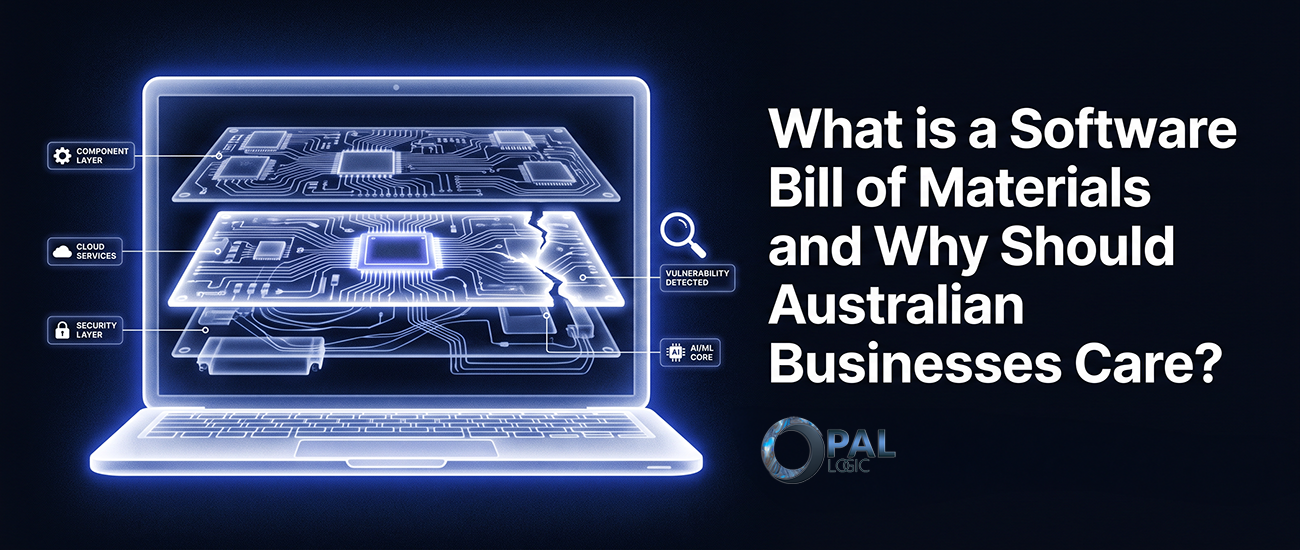
Modern applications are built from layers of software, third-party services, open-source libraries, APIs and other dependencies. Add artificial intelligence into the mix and that technology supply chain becomes even more complicated.
This is where a Software Bill of Materials (SBOM) becomes valuable.
Think of It as an Ingredient List for Software
An SBOM is essentially a detailed inventory of the components that make up a piece of software.
Just as an ingredient label tells you what is inside a food product, an SBOM can tell an organisation what is inside an application — including software components, dependencies and their versions.
That information can be extremely useful when something goes wrong.
If a vulnerability is discovered in a particular software library, an organisation with an accurate SBOM can potentially identify affected applications much faster than one relying on manual investigation.
Instead of asking:
“Which of our systems might be affected?”
the business can start with:
“Which of our applications contain this component?”
That difference can save valuable time during a cybersecurity incident.
The Software Supply Chain Is Getting Harder to See
Businesses increasingly depend on technology they didn't build themselves.
A typical business application might connect to an ERP system, payment platform, cloud service, third-party API and several software libraries. Each of these connections can introduce another dependency into the overall technology environment.
This creates what is often referred to as software supply-chain risk.
A vulnerability doesn't necessarily need to exist in software developed by your own organisation to become your problem. A weakness in a third-party component or service can potentially affect the applications and business processes that depend on it.
For Australian businesses, this is becoming an increasingly important cybersecurity consideration.
The Australian Cyber Security Centre (ACSC) has updated its guidance around SBOMs for 2026, highlighting their role in improving software transparency, identifying vulnerabilities and managing software supply-chain risks.
In other words, knowing what your software depends on is becoming an important part of knowing what your business depends on.
Then AI Changed the Equation
Traditional SBOMs are useful, but the software landscape is changing rapidly.
Artificial intelligence is now being integrated into business applications, customer platforms, productivity tools and internal systems.
And AI introduces components that don't fit neatly into the traditional idea of a software inventory.
An AI-enabled application could involve:
- AI models
- Training or external data
- APIs and third-party services
- Plugins and connected tools
- Databases and business applications
- Automated workflows and agents
This means understanding the software components alone may not provide the full picture.
A business could know exactly which libraries an application contains but still have limited visibility into what its AI system can access or what actions it is capable of taking.
The Question Is Changing
For traditional software security, one of the most important questions has been:
“What is this application made of?”
For AI-enabled systems, businesses increasingly need to ask several questions at once:
What is it made of?
What data does it use?
What systems can it access?
What external services does it connect to?
What can it do without human intervention?
This is an important shift.
AI introduces risks that aren't necessarily visible by simply listing software components. Threats such as prompt injection, data poisoning and misuse of connected tools can arise from how an AI system operates rather than from a traditional software vulnerability.
The result is a growing need for businesses to think about software transparency and AI governance together.
Why Should an Australian Business Care?
It might be tempting to think that SBOMs are something for software developers or large technology companies to worry about.
But businesses of all sizes rely on software they didn't develop themselves.
Your accounting platform, ERP, cloud applications, security tools, websites and integrations can all depend on third-party technology.
If a vulnerability is discovered, your ability to respond depends partly on how well you understand those dependencies.
An SBOM can help provide that visibility.
It can support businesses by making it easier to:
Identify vulnerabilities
Understand whether a known vulnerable component exists within your software environment.
Respond faster
Reduce the time spent searching through applications and suppliers when a new security issue emerges.
Understand third-party risk
Gain greater visibility into the technology being provided by software vendors and service providers.
Improve software management
Maintain a clearer record of what components and versions are being used across applications.
Support cybersecurity planning
Use better software visibility as part of a wider approach to managing cyber risk.
What Should Businesses Be Asking Their Software Providers?
You don't necessarily need to create an SBOM for every application your business uses yourself.
One practical starting point is to talk to your software and technology providers.
Ask:
- Do you provide an SBOM for your software?
- How are software components and dependencies tracked?
- How quickly are vulnerabilities identified and addressed?
- How are third-party and open-source components managed?
- If your product uses AI, what models and external services does it rely on?
- What data can AI functionality access?
- What security controls are in place around connected AI tools?
The answers can help businesses understand how much visibility they actually have over the technology they rely on.
From SBOM to AI Visibility
The rise of AI doesn't mean traditional SBOMs are no longer useful.
They remain an important foundation for understanding software dependencies and managing supply-chain risk.
But the conversation is expanding.
The article from UC Today highlights emerging approaches designed to provide greater visibility into AI-specific risks, including concepts such as AI-focused bills of materials and threat-modelling approaches.
The broader idea is that businesses may need to document more than just software components.
They may also need to understand the models, data, integrations, permissions and behaviours that make up an AI-enabled system.
For businesses adopting AI, this could become just as important as knowing which version of a software library is installed.
What This Means for Your Technology Environment
This is where the topic becomes particularly relevant for businesses managing complex technology environments.
Your software doesn't operate in isolation.
Your ERP may connect to your warehouse systems. Your applications may communicate with cloud services. Your customer communications may be integrated with your business software. AI tools may increasingly connect to internal data and applications.
Each connection creates dependencies.
The more interconnected a business becomes, the more important it is to understand those relationships.
At Opal Logic, we work with Australian businesses across IT infrastructure, cloud services, cybersecurity, software development, integrations and Jiwa Financials.
Our focus is helping businesses build technology environments that are connected, manageable and secure, whether that involves supporting existing systems, developing bespoke applications or integrating different platforms.
As software and AI become increasingly interconnected, understanding those relationships is becoming an important part of building a resilient technology environment.
The Bottom Line
An SBOM might sound like a highly technical cybersecurity concept, but the idea behind it is relatively simple:
Know what is inside the technology your business relies on.
That knowledge can make it easier to identify vulnerabilities, assess software supply-chain risks and respond when something goes wrong.
AI is now adding another layer to that challenge.
Businesses increasingly need to understand not only what software components they are using, but also what AI models are involved, what data they can access, what systems they connect to and what actions they can take.
For Australian businesses, building that visibility now can put them in a much stronger position as software and AI continue to evolve.
Because when the next major vulnerability is announced, the businesses that already know what is inside their technology won't have to start looking from scratch.


