


Why Essential Eight is Changing for Australian Businesses and What You Need to Know
For years, the Australian Government's Essential Eight has provided Australian businesses with a practical framework for improving their cybersecurity. Developed by the Australian Signals Directorate (ASD), it has helped organisations address common security risks through measures such as multi-factor authentication, patching, restricting administrative privileges and maintaining reliable backups.
However, the way businesses use technology has changed significantly since the Essential Eight was introduced in 2017.
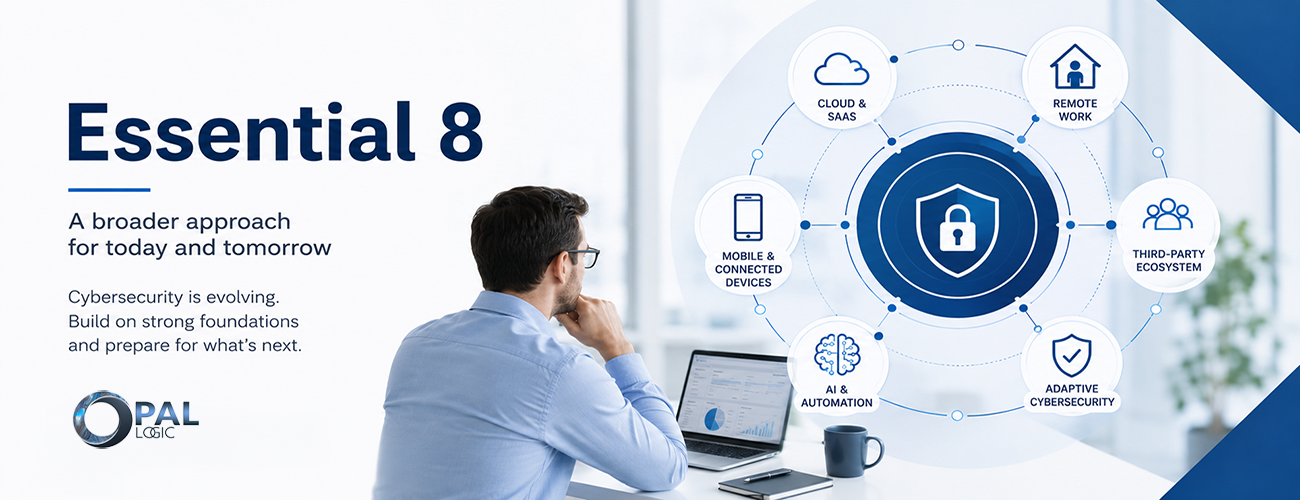
Today, organisations increasingly rely on cloud platforms, SaaS applications, remote workers, mobile devices, connected systems and artificial intelligence. As technology environments become more complex, ASD is developing a broader cybersecurity approach known as Essentials, with the existing Essential Eight expected to be retired over the next two years.
For Australian businesses, this change is less about abandoning the Essential Eight and more about expanding how they think about cybersecurity.
Why Is the Essential Eight Changing?
The Essential Eight was developed around a more traditional IT environment, where businesses commonly relied on corporate networks, desktop computers and on-premises servers.
Modern organisations operate across a much broader technology landscape. Businesses may now depend on:
- Cloud platforms and SaaS applications
- Remote and hybrid workforces
- Mobile devices and connected equipment
- Third-party applications and suppliers
- Artificial intelligence and automated systems
These technologies have created new security considerations that aren't always easily addressed through a fixed set of controls.
The new Essentials approach is intended to provide broader guidance that reflects these changing environments, including enterprise IT, cloud and operational technology.
This represents an important shift in cybersecurity thinking. Rather than focusing primarily on a defined list of controls, businesses will increasingly need to consider the specific risks associated with their own technology environment.
Does This Mean Businesses Need to Start Again?
No.
The transition away from the Essential Eight doesn't mean businesses should abandon the security measures they have already implemented.
ASD has indicated that existing Essential Eight investments will remain relevant during the transition. The controls businesses have put in place provide an important security foundation and will continue to be useful.
For businesses that have already invested in improving their Essential Eight maturity, the upcoming changes should therefore be viewed as an evolution rather than a complete reset.
The best approach is to maintain existing protections while gradually reviewing whether they address the broader risks facing the organisation.
What Isn't Changing?
The fundamental principles behind the Essential Eight remain valuable. Businesses should continue focusing on areas such as:
- Strong authentication and access controls
- Regular patching and software updates
- Restricting unnecessary administrative access
- Reliable and protected backups
- Monitoring and managing business devices
The new framework is expected to build on these foundations rather than make them irrelevant.
Cloud Is Changing the Security Landscape
Cloud computing is one of the clearest examples of how business technology has changed since the Essential Eight was introduced.
Moving systems and data to the cloud doesn't remove the need for security. Businesses still need to manage user accounts, permissions, configurations, devices and data.
Cloud environments also introduce shared responsibility. While cloud providers protect their underlying infrastructure, businesses remain responsible for many aspects of their own security.
This is where having an experienced technology partner can make a difference. At Opal Logic, we help businesses manage their IT environments and understand how their systems, applications, cloud services and security requirements fit together.
Whether a business is operating a traditional infrastructure, moving towards the cloud or managing a combination of both, having visibility over the technology environment is an important part of maintaining security.
AI Creates Another Layer of Complexity
Artificial intelligence is also creating new cybersecurity considerations.
Businesses are already using AI for content creation, data analysis, customer service, software development and other everyday tasks. More advanced AI agents may increasingly be able to interact with business applications, access information and perform tasks with limited human involvement.
This raises important questions around identity, permissions and data access.
If an AI system can access customer information, internal documents or business applications, organisations need to consider what it can access, what it is allowed to do and how its activity is monitored.
Opal Logic works with businesses to help them assess how new technologies can fit into their existing IT environments. As AI becomes increasingly integrated into business systems, this type of planning will become even more important.
What Should Australian Businesses Do Now?
Businesses shouldn't wait for the new framework to be finalised before reviewing their cybersecurity.
A useful starting point is to assess:
- Critical systems and data – Identify the systems and information that would have the greatest impact if compromised.
- User access – Review who has access to important applications, data and administrative functions.
- Cloud security – Check that cloud platforms and services are securely configured.
- Backups and recovery – Make sure backups are reliable, protected and regularly tested.
- Third-party technology – Consider whether external applications, suppliers or connected systems introduce additional risks.
- AI usage – Understand what AI tools are being used and what business information they can access.
These checks can help businesses identify potential gaps while continuing to build on the security foundations established through the Essential Eight.
This is also where Opal Logic can help. Rather than treating cybersecurity as a standalone IT task, we take a broader view of how technology supports a business. Understanding the systems a business relies on, how they connect and where potential risks exist can help create a more practical and effective technology strategy.
Preparing for the Next Stage of Cybersecurity
The transition from Essential Eight to Essentials provides businesses with an opportunity to look beyond compliance and consider their overall technology environment.
For Opal Logic, cybersecurity is part of a much broader IT strategy. Business systems, cloud infrastructure, networking, applications, user devices, data and security all need to work together.
A business might have strong authentication in place, for example, but still face unnecessary risk if its cloud environment is poorly configured or its backup strategy hasn't been tested.
Similarly, moving a business application into the cloud can provide significant benefits, but those benefits need to be supported by appropriate security, access controls and ongoing management.
By taking a holistic approach, businesses can make sure their technology isn't simply functional, but also secure, reliable and prepared for future changes.
Looking Ahead
The evolution from Essential Eight to Essentials reflects how dramatically business technology has changed since 2017.
For Australian businesses, the key message is simple: cybersecurity needs to evolve alongside technology.
Existing Essential Eight controls remain an important foundation, but organisations should also consider the wider environment in which they operate, including cloud services, connected systems, third-party applications, operational technology and emerging technologies such as AI.
The upcoming transition provides businesses with an opportunity to review their current security strategy, identify areas that may need greater attention and make sure their technology environment is ready for what comes next.
At Opal Logic, we work with Australian businesses to provide practical technology solutions across IT infrastructure, cloud environments, business systems, cybersecurity and application development. Our focus is on understanding how technology fits into the way each business operates, rather than taking a one-size-fits-all approach.
As the Essential Eight evolves, businesses don't have to navigate the changing technology and cybersecurity landscape alone.
The Essential Eight may be changing, but the need for strong, proactive cybersecurity isn't.


